






Let us help you find what you’re looking for


14 Aug 2025
Severe Combined Immunodeficiency Disorder (SCID) is fatal if left undetected, but newborn screening is giving affected babies a fighting chance. The case of baby Mannat Singh, who was diagnosed within a week of birth, underscores the critical importance of early testing.
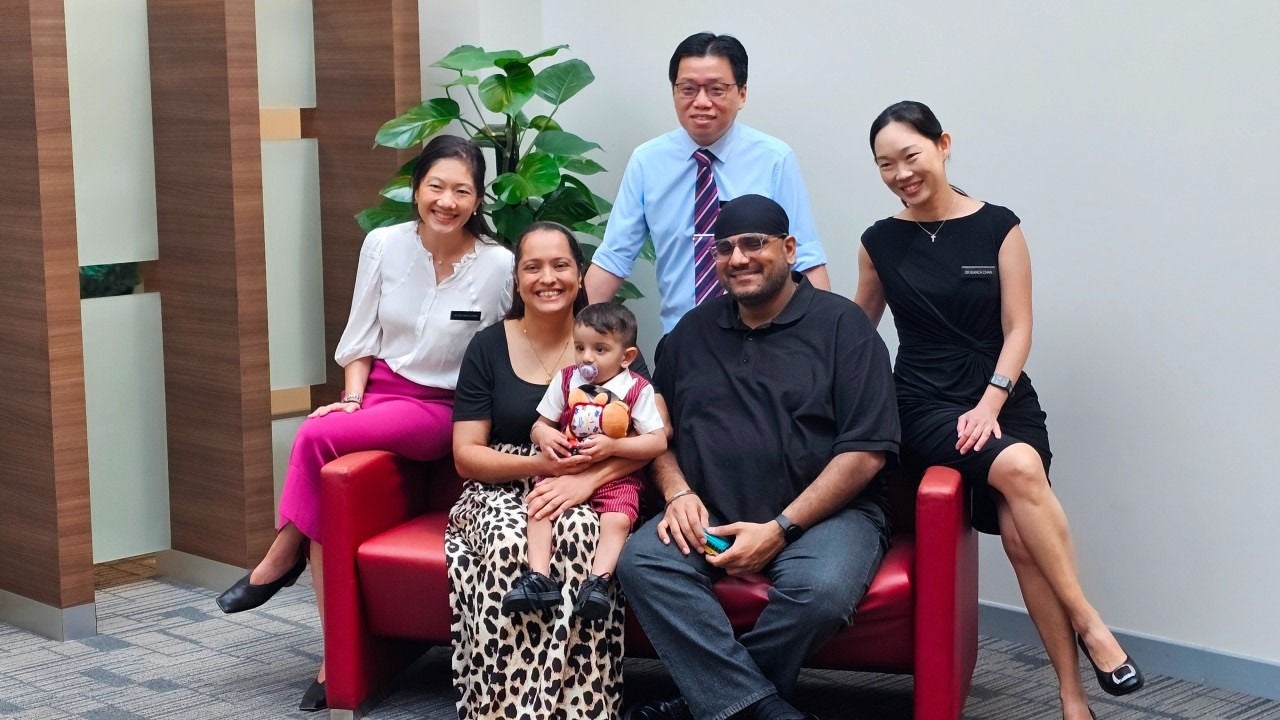
When Harminder Kaur and Harminder Singh welcomed their second child into the world, their joy quickly turned to anguish. Their newborn son, Mannat, was diagnosed with SCID – a rare condition that left him without a functioning immune system.
For babies like Mannat, even common infections can prove fatal. Without treatment, children with SCID rarely survive beyond their first birthday.
“It hit us really hard and we couldn’t help but question what we did wrong,” Singh recalled. Tearing up, he said, “We took it one step at a time and were prepared to do everything we could to give Mannat the best chance at life.”
The case for newborn screening
Mannat’s condition was picked up as part of a routine screening under the National Expanded Newborn Screening (NENS) programme. This involves pricking the heel of the baby for a blood sample within the first few days of birth to test for serious but treatable conditions. Newborn screening is now the standard of care-for every newborn at KK Women's and Children's Hospital(KKH), with nationwide uptake reaching approximately 96 per cent.
The NENS programme was launched in 2006 to screen babies for serious but treatable inborn errors of metabolism or genetic conditions that prevent the proper processing of nutrients, leading to either a buildup of harmful substances or lack of essential ones in the body. In 2019, it expanded to include five more serious childhood disorders including SCID, which affects approximately one in 50,000 people. Mannat was the first SCID case identified through this enhanced screening.
Without such screening in place, Mannat’s condition would have gone undetected until he developed a severe life-threatening infection, as children with SCID appear completely normal at birth.
Dr Ting Teck Wah, Senior Consultant, Genetics Service, KKH, and Director of NENS, explained that a child may be born with SCID even without any family history because the condition can be inherited in an autosomal recessive manner.
Every person has two copies of each gene, with one copy inherited from each parent. If one has a normal and a faulty copy of the gene, the person is a carrier of a particular condition but is usually well and symptom-free.
“However, when both parents are carriers of the same autosomal recessive condition, there’s a 25 per cent chance their child will be affected by the condition,” he said.
Treatment for SCID
Dr Bianca Chan, Consultant, Rheumatology & Immunology Service, KKH, shared that the only curative treatment for SCID is a Haematopoietic Stem Cell Transplantation. In this procedure, stem cells are harvested from a donor—usually a parent—and given to the child in a process similar to a blood transfusion. These stem cells then grow into a new, functional immune system that was previously deficient in the child.
Success rates from such stem cell transplantation can be as high as 95 per cent, if the child is treated before the onset of severe infections and usually before three to four months of age.
“If the baby is more than three and a half months old, or has an active infection before the transplant, unfortunately the survival rate falls to 50 per cent even with a transplant,” Dr Chan said.
For survivors who have had infections, health challenges may persist, added Dr Michaela Sng, Senior Consultant, Haematology / Oncology Service and Clinical Medical Director, Blood Marrow Transplant and Cell Therapy, KKH. She shared that of the five patients with SCID treated in the last decade, the three that presented with life-threatening infections continued to suffer lingering after-effects post-treatment.
“In contrast, the babies diagnosed by newborn screening and transplanted before the age of three and a half months and are infection-free before the transplant, did not experience any complications,” she said.
Comprehensive family support during treatment
Throughout this challenging journey, the healthcare team provides comprehensive support to families. This includes ongoing communication about the treatment plan and what to expect at each stage. Medical social workers work alongside the clinical team to help families manage the emotional challenges that come with a SCID diagnosis.
Medical staff prepare parents for extended hospital stays and frequent medical procedures, providing guidance on making the most of their time in the hospital while managing stress. They emphasise that parents must prioritise their own wellbeing through balanced nutrition, adequate sleep, and taking breaks, when possible. For families with other children, getting help from grandparents or friends can help alleviate some of the burden during this challenging period.
An early diagnosis becomes a saving grace

For Mannat, early detection saved his life. Within two weeks of birth, he was enrolled in a protective care programme to prevent infections. He was isolated at home and placed on antibiotics and antibody infusions. Due to his rare form of the disease – Artemis SCID – his doctors carefully avoided radiation-based treatments like x-rays to prevent complications.
At three months old, Mannat received a stem cell transplant from Kaur to replace his faulty immune system. He is now a healthy 19-month-old. Aside from routine check-ups to monitor his progress, he’s expected to live a normal life.
Looking back on the journey, Kaur is grateful that that the family is out of the woods and looks forward to raising a healthy and happy son. “We can now put the past behind us and focus on giving Mannat the best support we can to help him succeed in life,” she said.
Stay Healthy The Easy Way

Get trusted health advice, offers and more.
Stay Ahead in Healthcare Industry

Subscribe to our exclusive updates for healthcare professionals.















Keep Healthy With
 HealthXchange
 Health Videos
Follow SingHealth


© 2026 Singapore Health Services Pte Ltd. All Rights Reserved.