




Let us help you find what you’re looking for


19 Mar 2026

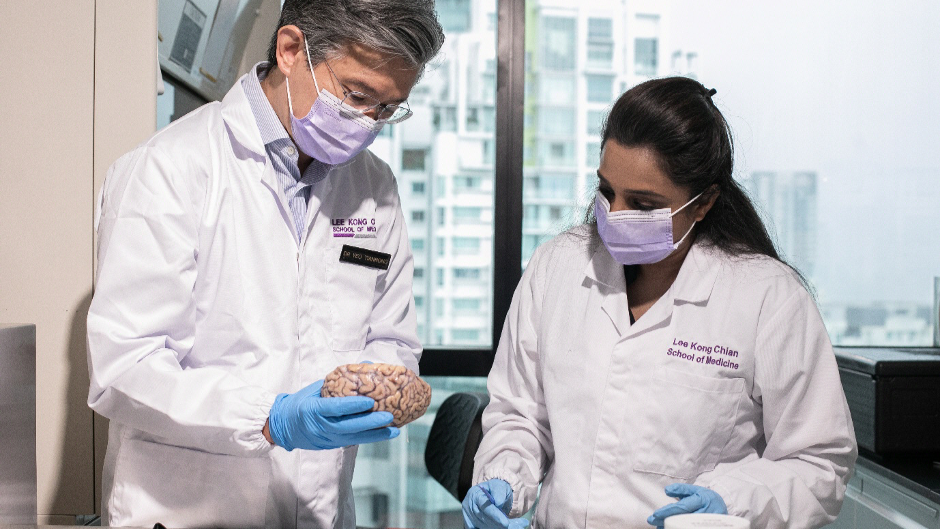
Our brains hold a lifetime of memories, details, and stories, shaping who we are long after our first heartbeat. Ever wondered what happens to the brain after one passes away? Tucked away in Novena is Singapore’s very first brain bank, where post-mortem brains are preserved and studied to unlock answers that living tissue alone cannot provide.

Tissue in post-mortem brains allow researchers to examine diseases directly within affected brain regions at a level of detail that cannot be achieved through brain imaging, blood tests, or other investigations in living individuals.

Samples are embedded in paraffin and stained for microscopic examination.
Under the microscope, scientists can observe pathological features including protein deposits, inflammation, vascular changes, and patterns of cell loss. These are then compared across brain regions and between disease and non-disease states.
Modern analytical platforms enable the detection of genetic, protein, and metabolic changes in brain tissue with remarkable precision. From a small piece of brain tissue, thousands of genes can be analysed simultaneously to reveal which genes are switched on or off in specific disease states.

Studies of brain and spinal cord tissue, for instance, have helped to establish neuromyelitis optica spectrum disorder (NMOSD) as a condition distinct from multiple sclerosis. These two conditions, while being distinct autoimmune disorders that attack the central nervous system, often manifest in similar symptoms such as vision loss and mobility issues.
This distinction has enabled more accurate diagnoses and the development of targeted treatments. In Singapore, this finding is particularly relevant as NMOSD is encountered more frequently here and in Asian populations than in the Western population. Such insights contribute to a more precise understanding of how neurodegenerative, neuroinflammatory, and neuropsychiatric conditions develop and progress.
From collection to research: How donated brains are processed at Brain Bank Singapore (BBS)
Becoming a brain donor is simpler than you might think – and open to anyone. After making the decision, you’ll meet a Brain Bank representative, either via video call or in person, to walk through the process. Once the consent form is signed, you’ll receive a Donor Card – a quiet reminder of the commitment you’ve made.
After a registered donor passes away, BBS arranges for the transfer of the body, with sensitivity to any specific religious rites; a consideration that is important in a multi-cultural society like Singapore. The retrieval of the actual brain and cerebrospinal fluid that cushions the brain – both of which form a post-mortem brain – takes place at the Academia on the Singapore General Hospital (SGH) campus, a purpose-built facility for medical research and education, before they are sent to BBS for processing. This procedure is done by National Neuroscience Institute (NNI) neurosurgeons or SGH lab technicians.
The post-mortem brains are then divided into two hemispheres – one snap-frozen and stored in a -80°C freezer, and the other preserved and prepared for microscopic examination. This adheres to standard international brain banking practices, which makes it possible for comprehensive molecular and microscopic investigations to be conducted from each donor so that researchers can maximise the research yield of these invaluable specimens.
Undergirding the delicate and sophisticated operations of BBS is a comprehensive Laboratory Information Management System (LIMS), which ensures that each specimen is accounted for and carefully preserved. The system provides a comprehensive digital oversight from retrieval through processing and distribution so that there is full traceability of every tissue sample, while maintaining rigorous quality control and ensuring there is efficient sample management throughout the research pipeline.
Why the brain needed a bank of its own
BBS began with a simple but pressing question: how do you study the local brain, without local brains to study?
Launched in 2019, BBS was born out of a growing concern among clinicians and researchers who saw dementia, Parkinson’s disease, and other neurological conditions rising in Singapore, while much of the current research relied on donated brain tissue from overseas. Those samples, while invaluable, could not fully capture the genetic makeup, lived experiences, and environmental influences unique to this region. What followed was a ground-up effort by local clinical and academic leaders to build a national resource of our own.
BBS is the first of its kind in Southeast Asia. Apart from NNI, researchers at BBS come from partner institutions in academia, healthcare institutions and research agencies across Singapore including Lee Kong Chian School of Medicine, NHG Health, NUS Yong Loo Lin School of Medicine , Duke-NUS Medical School, and A*STAR - Agency for Science, Technology and Research Institute of Molecular and Cell. These strong partnerships have been instrumental in the establishment of BBS, with a significant proportion of BBS donors recruited through NNI’s neuroscience clinics, and more cross-institutional collaborations to come.
With tissue samples already supporting active research projects, BBS continues to expand its bank as more donors come onboard to participate in this vital work of advancing brain research in Singapore. Asst Prof Tianrong Yeo, Deputy Director of BBS and Head and Senior Consultant, Department of Neurology, NNI@TTSH, shares,
“BBS’s goal is to be a comprehensive brain resource that contains not just the physical brain specimens, but also rich molecular and genomic data associated with each sample. We hope that BBS will be the wellspring that ignites new research ideas, catalyses exciting collaborations and trailblazes neuroscience breakthroughs that will enable us to find answers and new treatments to the brain conditions that affect our population.”
It is with this mission in mind that BBS is working hard to also extend its reach across the region and fostering collaborations with leading research institutions and brain banks worldwide to contribute to important scientific discoveries. This is particularly important in bridging critical gaps where Asian brain tissue has been underrepresented in global research.
The human brain: the body’s command centre and most intricate organ, and the most complex structure known to science. It shapes the way we think, feel, and experience the world. Advancing brain research, therefore, holds the key to unlocking transformative breakthroughs in health and disease that has the potential to change lives, touch families, and transform communities. BBS holds the key that can unlock this potential – to demystify and find answers to the complexities of the brain even after life ends.
Stay Healthy The Easy Way

Get trusted health advice, offers and more.
Stay Ahead in Healthcare Industry

Subscribe to our exclusive updates for healthcare professionals.














Keep Healthy With
 HealthXchange
 Health Videos
Follow SingHealth


© 2026 Singapore Health Services Pte Ltd. All Rights Reserved.