




Let us help you find what you’re looking for


17 Nov 2025
A Broadway singer sat across from Dr Christina Ng, troubled by a vocal fold lesion that had developed. In the high-stakes world of Broadway, where understudies wait in the wings, dropping out wasn't just about missing a show; it could mean losing a role he'd worked years to secure.
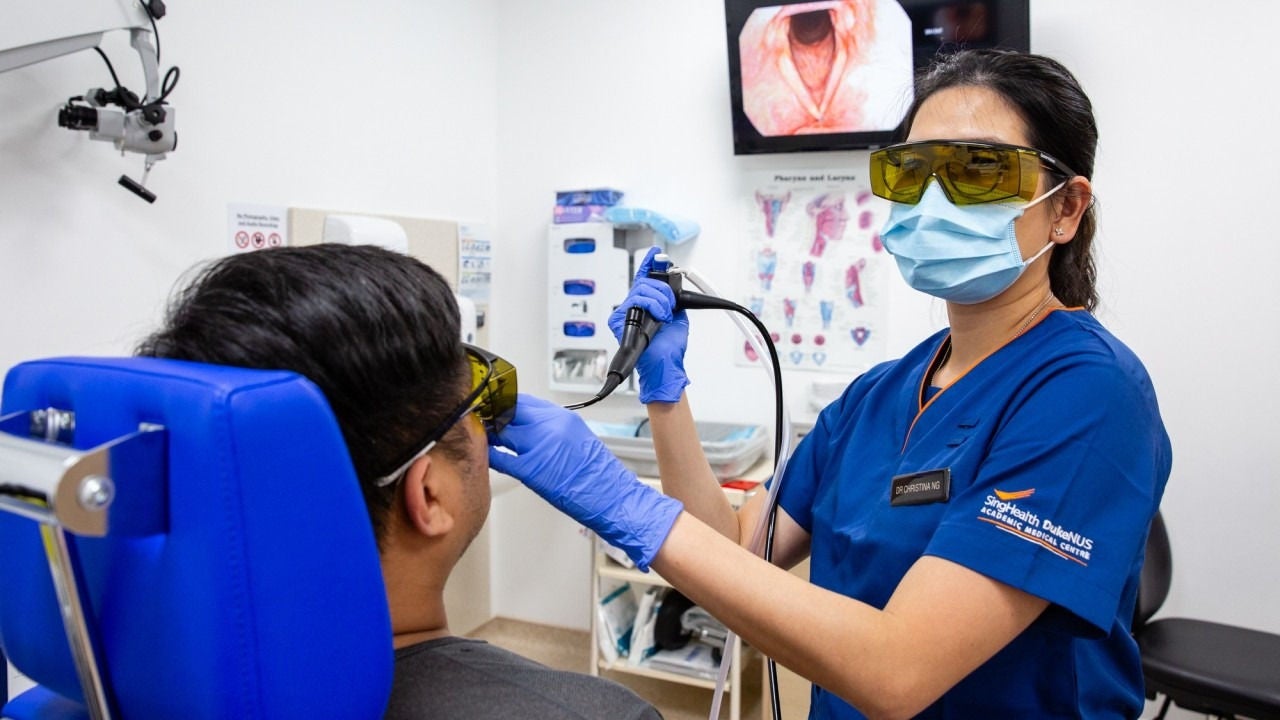
“For a singer, losing their voice right before an opening show can feel devastating. With the blue light laser technique, we managed to restore his voice in time, allowing him not just to perform, but to hold on to his passion and career,” recalls Dr Ng, Consultant, Department of Otorhinolaryngology at Sengkang General Hospital (SKH), who saw this patient when she underwent a one-year fellowship in laryngology (voice box-related disorders) and bronchoesophagology (conditions involving the airway and swallowing) at Stanford University under the Health Manpower Development Programme (HMDP) by the Ministry of Health.
Now a year later, Dr Ng is back in Singapore, bringing the blue light laser technique to local patients for the very first time.
Revolutionising voice restoration
The clinic-based voice box treatment using blue light laser is an advanced minimally invasive procedure for treating a range of throat and voice disorders, especially those involving vocal cord lumps or growths like polyps, cysts and papillomas.
Widely used in the United States, Europe and Australia, the laser emits light in the blue spectrum with the highest absorption in hemoglobin, melanin and pigment, resulting in high selectivity between different types of tissue, ensuring a high degree of precision in targeting vessels or pigmented lesions while minimizing laser effect on adjacent tissue. This clinic-based treatment can be done as a quick outpatient procedure in the clinic and the patient can resume normal activities after the procedure.
By all measures, this blue light laser technique marks a huge positive shift for doctors, and for patients’ experience.
In the past, this technique was unavailable in Singapore due to the lack of expertise. As such, the standard treatment for benign or early-stage growths involved invasive surgery under general anesthesia and intubation. This often-carried risks such as injury to the tongue, teeth, gums, or lips, as well as several days of postoperative sore throat. It was costlier, plus there was also significant time spent on pre-surgery appointments.
Beyond voice; preserving identity
While on the HMDP programme Dr Ng trained under some of the world’s top specialists and gained hands-on experience in performing the blue light laser technique so that she can incorporate the treatment safely into practice at SKH.
“Our patients at SKH, particularly those who use their voices professionally like educators, salespersons and call centre staff, stand to benefit greatly. The technology enables safer interventions, which translates to faster recovery, better voice outcomes and lower risks of complications,” she explains.
Beyond gaining the technical know-hows at Stanford, Dr Ng was inspired by the strong culture of innovation and willingness to adopt new technologies after rigorous evaluation. “I appreciated how surgical excellence was matched by a commitment to quality of life, especially in voice preservation,” she shares.
Her experience in treating the Broadway performer brought home the reminder that “in laryngology, we’re not just treating a lesion. More importantly, we are preserving the identity, livelihood and passion of the patient,” says Dr Ng. “This approach to care is something I’m committed to bringing back and nurturing at SKH.”
While the blue light laser technique is still in its early days in Singapore, Dr Ng envisions the non-invasive treatment becoming increasingly relevant and in-demand among young patients in Singapore, who tend to be proactive about managing their health.
“With the rise of video conferencing, voice-activated devices like Alexa and Siri, and increased exposure through social media, people are becoming more aware of their voice quality and the treatments available. This awareness will drive more patients to seek help earlier,” explains Dr Ng.
Building a beacon for laryngology
Since returning to Singapore, Dr Ng has been sharing her knowledge of the blue light laser technique and other laryngeal procedure techniques with colleagues at SKH and ear, nose and throat (ENT) residents across Singapore. As one of the few doctors in Asia familiar with the technique, she is also contributing her knowledge and insights via regional conferences and academic publications.
Ultimately, her goal is to help develop SKH into a multidisciplinary regional training hub for laryngology – one that “continually grows, innovates and inspires the next generation of ENT clinicians.” The introduction of blue light laser technique as a treatment modality is one of many steps Dr Ng is taking to advance the capabilities and know-how of SKH’s voice programme.
For Dr Ng, her passion to make a difference is her driving force behind introducing new techniques such as the blue light laser. “Being able to contribute to better care and outcomes through new techniques has been deeply meaningful,” she shares.
Stay Healthy The Easy Way

Get trusted health advice, offers and more.
Stay Ahead in Healthcare Industry

Subscribe to our exclusive updates for healthcare professionals.















Keep Healthy With
 HealthXchange
 Health Videos
Follow SingHealth


© 2026 Singapore Health Services Pte Ltd. All Rights Reserved.