





Let us help you find what you’re looking for.
02 Feb 2026 | The Straits Times
NUHS tracks kids’ sleep with PROMs

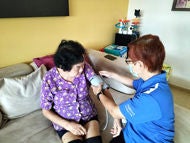
NHG Health’s chief of health services and outcomes research John Abisheganaden examining Madam Merly Hong, a patient with Tan Tock Seng Hospital since 2016.
ST PHOTO: CHONG JUN LIANG
SINGAPORE – Now more than ever, patients are taking their health into their own hands.
With the implementation of patient-reported outcome measures (PROMs), which could be simple questionnaires to complete, some patients in public hospitals can assess and report their own health statuses.
The PROM scores are then used to determine if they can be discharged from hospital to continue receiving care in the community, or if closer medical attention is warranted instead.
The three public healthcare clusters in Singapore have implemented PROMs in some of their disciplines, said Senior Minister of State for Health Koh Poh Koon in October 2025.
This gives patients a voice in clinical decision-making, helping them to better understand their own progress and become more engaged in managing their own care, he said when speaking at the Singapore Health and Biomedical Congress about how the Republic is prioritising the implementation of appropriate and value-based care (AVBC).
PROMs are an example of AVBC, which focuses on what truly matters to patients and ensures healthcare is delivered in a way that is guided by evidence, with patient outcomes that improve their lives while ensuring every dollar spent delivers optimal value.
NHG Health in the central region has implemented the Global Initiative for Asthma (GINA) PROMs at its specialist outpatient clinics and polyclinics.
The questionnaire for patients includes queries on whether they have experienced daytime asthma symptoms more than twice a week in the past four weeks, and woken up at night because of the symptoms.
When completed, the questionnaire gives them a GINA score, a measurement of whether their asthma is well-, partly or badly controlled.
NHG Health’s chief of health services and outcomes research John Abisheganaden said the questionnaire helps clinicians focus on the specific asthma attacks that patients might not have told their doctors about.
A standardised scoring system can help with patient care, too, by providing a common clinical language across the care team.
“For instance, we know exactly what ‘this patient has a GINA score of 2’ means, just like different doctors can understand blood pressure or blood sugar level readings”, said Professor Abisheganaden, who is also a senior consultant at Tan Tock Seng Hospital (TTSH).
More importantly, the longer-term tracking of these scores can give clinicians a clearer picture of whether the patients have well-controlled asthma. Those who keep their GINA score at zero for at least six months can be considered for discharge from the specialist clinics to primary care, said NHG.
Patients also find the system to be useful.
Madam Merly Hong, who has been a patient with TTSH since 2016, started using the GINA questionnaire in August 2022.
The 69-year-old retiree, who has had asthma since she was 35, finds it useful to be able to track her GINA scores from several visits.
“It gives me the reassurance that I am doing well when the scores remained low. Filling up the questionnaire also helps me to recall the times when I had attacks and identify possible triggers to avoid future attacks,” said Madam Hong.
As her asthma was relatively poorly controlled, she has been using biologics – targeted biological therapies that act on specific inflammatory pathways – since August 2022.
She injects them herself once every four weeks into her stomach area or thigh, on top of taking the conventional asthma medication. With those therapies, she has seen a marked improvement of her asthma.
NHG has implemented PROMs in other areas of patient care, including total knee replacement and polypharmacy, and is exploring using them in other clinical areas such as mental health.
NUHS tracks kids’ sleep with PROMs
The National University Health System (NUHS) in the west has implemented PROMs for the sleep management of infants and children, as poor sleep can affect a child’s mood, behaviour, learning and growth, and cause great stress to parents.
Under the Sleep Easy Programme, parents fill out an online questionnaire about their baby’s sleep shortly before the child is due for well-baby checks and recommended immunisations, said NUHS.
The PROM answers provide the doctors with insight into the child’s sleep quality, and screening can be arranged for those with potential sleep problems, said Associate Professor Daniel Goh, a senior consultant at the National University Hospital’s paediatric pulmonary medicine and sleep division.
He also said that the use of standardised parameters allows for tracking and monitoring of the child’s sleep quality over time.
NUHS’ preliminary findings showed that the questionnaire is able to effectively screen infants’ sleep and, with NUHS’ intervention, improve sleep quality, said Prof Goh. Parents also reported better confidence in managing their infants’ sleep.
NUHS’ director of the Value Driven Outcomes Office, Ms Shikha Kumari, said PROMs have been rolled out across the healthcare cluster, including the sleep-related screening programme at its polyclinics and for other conditions such as total knee replacement, total hip replacement and stroke.
She said NUHS’ future PROM roll-outs will prioritise high-value clinical areas.
Contributed by


Stay Healthy The Easy Way

Get trusted health advice, offers and more.
Stay Ahead in Healthcare Industry

Subscribe to our exclusive updates for healthcare professionals.













Keep Healthy With
 HealthXchange
 Health Videos


© 2025 SingHealth Group. All Rights Reserved.