





Let us help you find what you’re looking for


23 Oct 2025
When Cheryl Tan was diagnosed with Multiple Scoliosis (MS) 10 years ago, her world changed overnight. Within a few short years, the weakness in her legs left her wheelchair-dependent. Alongside her physical challenges, she felt helpless and the emotional strain of navigating public spaces.
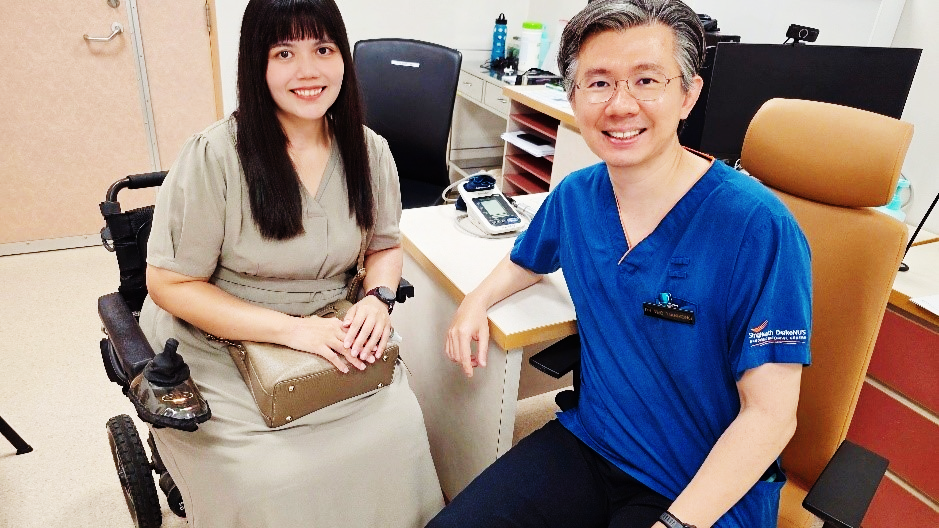
What made all the difference was the partnership with her neurologist Assistant Professor Tianrong Yeo, Head and Senior Consultant, Department of Neurology, National Neuroscience Institute . Having witnessed Cheryl's vibrant spirit and her deep love for discovery throughout their consultations, Prof Yeo understood that mobility meant far more than mere transportation for her; it represented freedom, independence, and the ability to continue living life to the fullest.
Before her diagnosis, Cheryl had been the embodiment of an adventurous soul. She enjoyed exploring different parts of Singapore in her free time. This zest for life and natural curiosity had defined who she was.
Recognising that Cheryl's active lifestyle as integral to her wellbeing, Prof Yeo became more than just her medical practitioner. He became her advocate and champion. Understanding her deep-seated desire to roam freely and pursue her passions, he encouraged her to work towards getting her driver's licence, knowing it would restore not just her ability to be independent, but her sense of self.
His steadfast support helped her regain confidence; eventually enabling Cheryl to successfully obtain her driver's license. Prof Yeo patiently guided her through each step of the process, ensuring she felt supported throughout the journey.
"There were many administrative hurdles, such as obtaining a doctor's memo to apply for a driver’s license. I couldn't have gotten my license without Prof Yeo, so I'm very thankful," recalls Cheryl.
"He understood that my ability to drive wasn't just about getting from point A to point B for me—it was about being able to continue exploring, discovering, and living the life I love. His belief in me gave me the strength to push through all the challenges."
Meanwhile, Mohan D Pillay was fighting healthcare battles of a different kind. Years of caregiving and hospital visits as he supported his mother with advanced dementia, cared for his son after a traumatic accident and his own recurrent treatment at Singapore General Hospital wore him down. However, it gave him a deep appreciation for the importance of community support and clear communication between doctors, patients and caregivers.
Cheryl and Mohan’s journeys have one thing in common: strong doctor-patient relationships can spark real change.
Improving healthcare communication to support patients and caregivers
Having joined SingHealth Patient Advocacy Network (SPAN) in 2019, Mohan moved from being a recipient of healthcare advice to becoming a healthcare collaborator through his work as co-chair of SPAN@DEM (Department of Emergency Medicine), a department-level patient advocacy group nested within the broader SPAN network.

Mohan and Dr Ng sharing about SPAN@DEM with patient experience professionals from other healthcare clusters
Together with Dr Ng Mingwei and Dr Zhenghong Liu — both of whom are Consultants at the DEM, Singapore General Hospital—Mohan co-organises activities that directly impact patient experience. He coaches junior doctors in patient and caregiver communication through a two-hour workshop twice a year. So far, more than 20 doctors have participated in these workshops.
“These junior doctors are very skilled in the clinical aspects of their work and may have the tendency to focus on explaining to the next-of-kin the details and condition of the patient in a very technical manner. However, in times of distress, what families and caregivers need is to be able to understand, and have more emotional and psychological support and guidance on the way forward,” says Mohan.
He also worked closely with the clinical team on developing CommunicAid, a series of visual aids to standardise and simplify how doctors explain serious medical issues and complex procedures like coronary angioplasty.
“This is especially important for DEM doctors who are handling critical cases. This tool helps patients and their next-of-kin to quickly and easily understand what is being communicated,” Mohan explains. This not only enhances patient understanding and satisfaction with their care but also facilitates quicker consent for time-sensitive, life-saving procedures, ultimately leading to improved patient outcomes.

Mohan (fourth from left), Dr Ng (middle standing in white) and Dr Liu (seated) with fellow SPAN@DEM advocates
Helping MS patients lead fuller lives
For Cheryl, a customer experience and inclusivity officer with bus operator Tower Transit Singapore, her desire to help fellow patients with MS gain confidence and mobility in everyday life was apparent long before she joined SPAN in April 2023.
To mark World MS Day in May 2022, she co-organised an educational event at Sembawang Bus Interchange, teaching patients how to safely and confidently board and alight the bus. Her doctors from NNI took part in the event as well, giving a talk to raise awareness of MS.
“Patients with mobility challenges, even non-wheelchair users, face varying degrees of difficulty that may not always be apparent. Meanwhile, wheelchair users need to traverse narrow bus ramps that can create anxiety about potential falls. Our event aimed to help patients feel less shy to ask for help,” she shared.
She has also volunteered for a spectrum of other projects, including serving as a judge for the NNI Compassionate Care Award.
A project close to her heart was providing early feedback for the redesign of KK Women's and Children's Hospital Urgent O&G Centre in early 2025. Drawing from her own patient experience at KKH, she suggested ways for wheelchair users to collect urine samples more easily and identified potential safety hazards, among other improvements. These changes will also benefit heavily pregnant women who may have movement constraints.
Collaborating for the greatest good

Cheryl (right in pink) and Mohan (last row in blue) at the SPAN Year-End Party 2024.
The impact that Cheryl and Mohan have made came from a common place. The trust and openness they have experienced in their relationships with doctors gave them the courage to speak up, and the SPAN platform has allowed them to turn that voice into action.
“What I’ve seen is genuine receptiveness of our presence and views, and the healthcare teams trying their best to incorporate our suggestions and ideas whenever possible,” Mohan says. “I look forward to scaling our efforts accordingly so more patients and their families can benefit from these ideas.”
Similarly for Cheryl, the work is far from done, “What’s important for me now is to facilitate real change so patients can benefit in future,” she said.
Stay Healthy The Easy Way

Get trusted health advice, offers and more.
Stay Ahead in Healthcare Industry

Subscribe to our exclusive updates for healthcare professionals.















Keep Healthy With
 HealthXchange
 Health Videos
Follow SingHealth


© 2026 Singapore Health Services Pte Ltd. All Rights Reserved.