SingHealth Institutions will NEVER ask you to transfer money over a call. If in doubt, call the 24/7 ScamShield helpline at 1799, or visit the ScamShield website at www.scamshield.gov.sg.
Decoding Dementia: Breakthroughs in Brain Research
19 Jan 2026
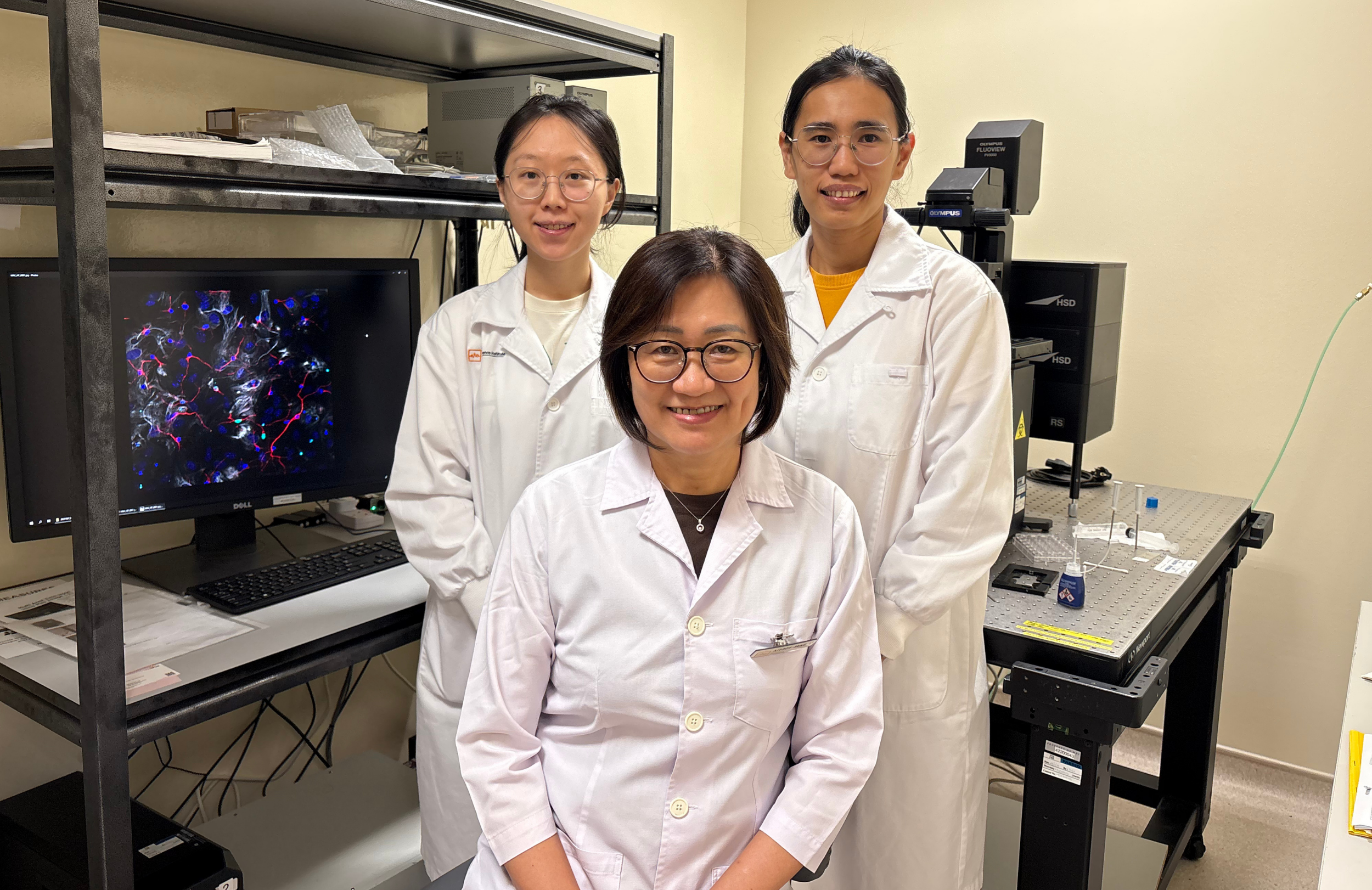
Assoc Prof Zeng Li (centre) with her team (Chia Sook Yoong on the right; Li Zhihong on the left)
Alzheimer’s Disease (AD), Dementia with Lewy Bodies (DLB), and Parkinson’s Disease Dementia (PDD) may look different in their symptoms, but a new study has revealed that they may share the same underlying biological problem. Associate Professor Zeng Li, Principal Investigator, NNI, and her team discovered a harmful cycle involving damaged myelin (the insulation that protects nerve fibres) and overactive microglia (brain immune cells) in the brain.
With the help of advanced genetic sequencing, the collaborative teams from Assoc Prof Zeng Li and Assoc Prof Chen Jinmiao analysed brain tissue from the prefrontal cortex – an area essential for memory, planning, and decision-making – of individuals with and without dementia. In this area, they identified a unique condition of microglia cells. These cells normally support brain development and help clean up accumulated toxic materials in the brain. However, in dementia including AD, DLB and PDD, they were filled with unusually large amounts of myelin, suggesting they were cleaning up myelin far more actively than they should. This excess myelin waste can harm the brain and contribute to memory loss.
Changing the Way We View Dementia
At the centre of this discovery also lies a gene called MSR1 (macrophage scavenger receptor 1). MSR1 typically helps microglia clear away toxic materials, including damaged myelin. When MSR1 becomes overactive, they become even better at clearing myelin. However, as more myelin waste builds up, MSR1 levels increase further. Over time, this creates a cycle that may worsen memory and thinking problems seen in AD, DLB and PDD. Another gene, HSPA1A (heat shock 70kDa protein 1A), was more active in oligodendrocytes, which are cells that build myelin. Interestingly, these two cell types were found unusually close together in dementia, suggesting that their increased interaction may contribute to myelin damage in all three conditions.
“These two types of cells communicate with each other and work together in a way that drives brain degeneration,” Assoc Prof Zeng explained.
Although these three dementias present differently, they seem to share a core biological mechanism involving:
Myelin damage
Overactive microglia
Increased MSR1 activity
Sook Yoong filtering cell culture media as Assoc Prof Zeng oversees
Future Direction
Yet, MSR1 is not all bad news, as its activity in clearing amyloid-beta plaques is protective. MSR1 helps microglia clear damaged myelin and was more active across all dementia types, thus it can be investigated as a potential target for treatments that could work across multiple forms of dementia.
“We may be able to slow or interrupt this damaging cycle if we can safely regulate MSR1 activity,” noted Assoc Prof Zeng.
These insights could pave the way for new therapies – whether through drugs or gene-based treatment – that enhance microglia’s protective role of clearing damaged myelin.
Furthermore, Assoc Prof Adeline Ng, head of the dementia programme at NNI, notes the potential for early detection. By studying when MSR1-related changes first appear and how they correlate with disease progression, researchers hope to develop biomarkers – measurable signals in the brain or blood – that can detect early signs of dementia in a person before symptoms become irreversible.