






Let us help you find what you’re looking for


26 Sep 2025
From bedside insights to breakthrough innovations, SingHealth nurses are leading the charge in transforming patient care through creative solutions that make care smarter, safer and more accessible.
A drip reader that enables patients to receive intravenous therapy in the comfort of their own home. Applications, available via a bedside tablet, that give patients easy access to their own medical records while empowering them to gain self-monitoring skills for better health outcomes post discharge. A virtual reality trainer that will change the way nurses learn essential protective equipment and hand hygiene protocols.
These are some of the inventive solutions that address real challenges faced by patients and healthcare workers daily and have emerged from those who know patients’ needs best: nurses. As frontline caregivers who spend the most time with patients, nurses are uniquely positioned to spot gaps in care delivery and devise practical solutions.
Making an impact beyond bedside duties
This natural alignment between nursing and innovation was what led SingHealth to establish innovation as its sixth nursing specialist track in 2022 (alongside clinical, education, research, leadership and informatics), a firm belief in the the power of nurses to transform care.
The establishment of the innovation track formalised what began over a decade ago, when there was awareness that more needed to be done to augment the national nursing manpower shortage. Nurses began to dedicate extra hours to innovation projects, particularly those that would improve workflows and increase efficiency.
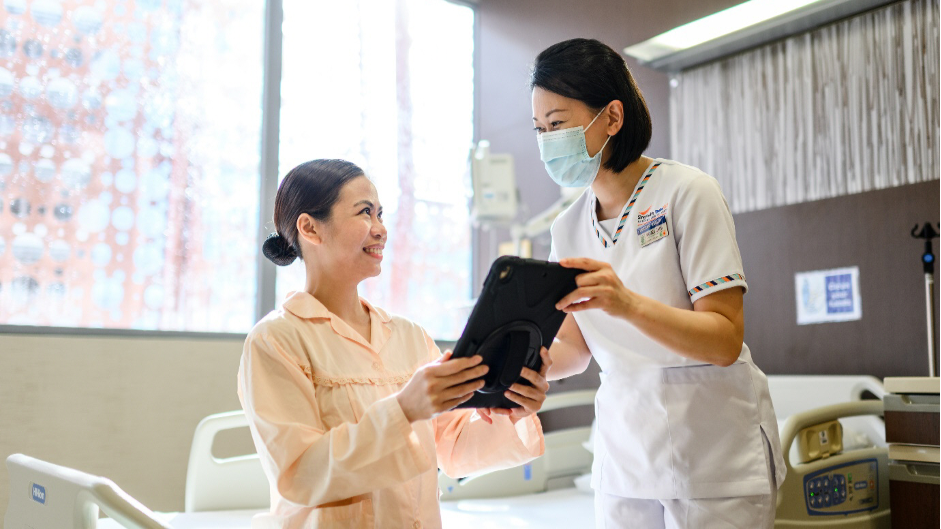
For instance, with the bedside tablet, inpatients need not call for assistance when they wish to check their lab test results or appointment. An asset management system using RFID technology also eliminates the need for manual and time-consuming equipment stocktaking processes.

“Nurses were putting in hours outside of their shifts to work on these innovation projects. Over time, we felt the need for more recognition, support and protected time for these staff,” recalls Ms Sook Thow Wong , Deputy Group Chief Nurse of SingHealth (Nursing Transformation).
Organisational support brings great ideas to life
To nurture the spirit of innovation, SingHealth Nursing has been progressively ramping up ways to support and advance the aspirations of nurse-innovators.
One important way is by connecting project groups with vendors or technical teams for co-creation and providing upskilling opportunities. To foster a vibrant innovation spirit among nurses, in the pipeline is a foundational course that will help SingHealth nurses understand the basics of innovation and how they can apply these concepts in their daily work and spheres of influence.
Interested staff can join the Nursing Innovation Councils in the respective institutions across SingHealth, which facilitate the exchange of ideas and explore scaling up initiatives within the cluster. Innovation efforts are also given recognition in nurses’ yearly performance appraisals.
“In our drive to foster a culture of creative problem solving, even informal channels like the notice board in a ward have become a way for nurses to jot down innovative ideas for improvement,” Ms Wong shares.
The desire to elevate care through innovation is most evident at the SingHealth Nursing Innovation Challenge, which attracts about 40 to 50 submissions each year from nurses across the cluster.
Proposals received from the Challenge have covered a wide range of ideas to improve healthcare delivery, streamline work processes and more. A judging panel picks the top 10 teams with the best ideas to each receive a $5,000 seed grant to develop a proof-of-concept. After three successful runs, there are now 30 projects at different stages of development.
For example, the Drip Reader by the Singapore General Hospital (SGH) started as an Innovation Challenge entry. The team is now exploring market opportunities with their solution.

Prototypes of Drip Reader
The Drip Reader has been particularly well-received by nurses based in the community, as it allows them to provide home-based care in a safer and more efficient manner. Now in the clinical trial phase, the Drip Reader will be tested both in the hospital and community settings, prior to being made commercially available to benefit more patients and nurses. Its key innovation developments include a bigger viewing screen for easy reading, availability of adapters to fit the different types of drop administration set, longer battery life, as well as a display screen showing battery life.

Drip Reader
Another standout innovation is the Blue Mirror Personal Protective Equipment (PPE) and Hand Hygiene (HH) Trainer, which has transformed the way nurses learn critical safety protocols. Successfully implemented across eight SingHealth institutions including SGH, Sengkang General Hospital , Changi General Hospital , KK Women's and Children's Hospital , SingHealth Polyclinics , National Cancer Centre Singapore , National Dental Centre Singapore and Singapore National Eye Centre , the virtual reality-based trainer captured data from 717 unique participants during its trial phase and has saved approximately 10.2 hours on PPE and HH training.

Set-up for competency sessions
The Blue Mirror trainer has now replaced face-to-face training for new nurses at SGH, a testament to the capabilities of technology in enhancing both learning outcomes and operational efficiency.
Necessity is the mother of invention
While some may argue that the chronic shortage of nursing professionals is detrimental to the spirit of innovation, there is another more optimistic perspective. “Innovation among nurses will only continue to grow and become more crucial because of the need for manpower augmentation,” says Ms Wong, who points to the increased adoption of robotics and artificial intelligence as potential solutions for the future.
Even in the face of manpower constraints, innovation projects among nurses are often driven by a deeper calling, Ms Wong added. “Many of these solutions make an immediate impact on patient care. That, to me, is what make innovation purposeful, meaningful and interesting.”
Stay Healthy The Easy Way

Get trusted health advice, offers and more.
Stay Ahead in Healthcare Industry

Subscribe to our exclusive updates for healthcare professionals.
















Keep Healthy With
 HealthXchange
 Health Videos
Follow SingHealth


© 2026 Singapore Health Services Pte Ltd. All Rights Reserved.