






Let us help you find what you’re looking for


23 Jun 2025
Armed with over two decades of experience, Robyn Yip shares an inside look into how clinical trials are conducted as a clinical research coordinator.Have you ever tried baking five different cakes in separate ovens at the same time? I have.
At least, it feels like that on most days for us as clinical research coordinators (CRCs) who are also champion multi-taskers. We work together with Principal Investigators (PIs), various clinical and administrative departments, regulatory bodies, patients and healthy volunteers to ensure the smooth execution of a clinical trial from start to end.
The scope of our work is both broad and deep. Once a clinical trial is approved, it is our job to keep things moving forward on time, keeping in line with protocol, within legislation and with the utmost care for patient safety. On a typical day, we will work on submitting paperwork to the Health Sciences Authority and Centralised Institutional Review Board, brief study participants, meet trial sponsors, make logistical arrangements, check in on the well-being of patients and much more.
At any one time, a CRC is involved in anything between three and six trials, each with its own protocol and objectives. Each trial brings with it the precision that is required to ensure that results are accurate and reliable. For example, every step we take at the clinic, from drawing blood samples to running ECGs, is timed to the minute. Any deviation from the protocol can affect trial results as well as the reliability and effectiveness of the trial. Just like in baking, every “cake” (trial) we bake has its own recipe that needs to be followed to a T.
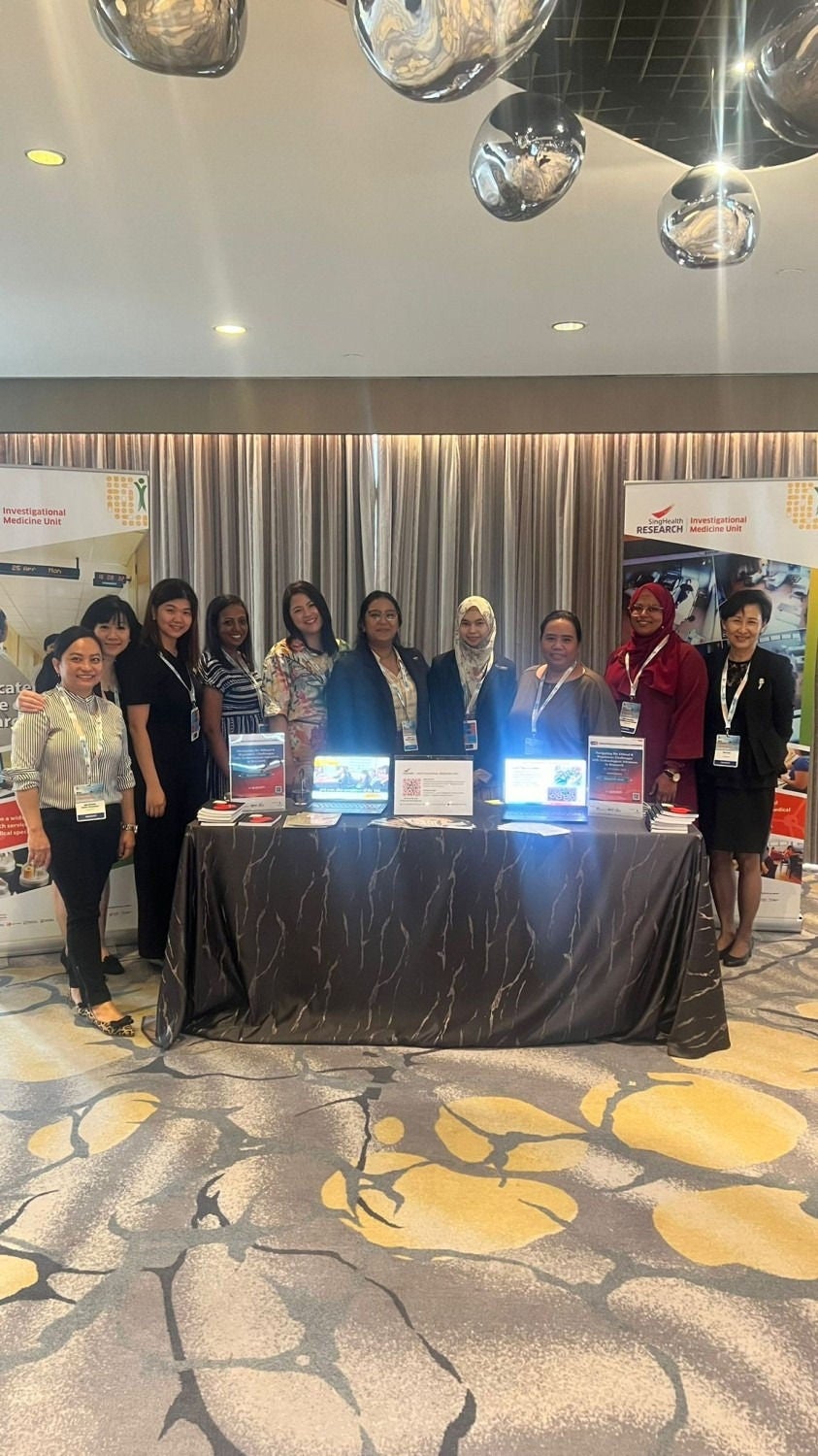
 Robyn Yip (third from left)
As a Senior Principal CRC at SingHealth’s Investigational Medicine Unit, I have the privilege of being involved in Phase 1 trials, where groundbreaking drugs and treatments are tested on humans for the very first time. We are also vigilant about the potential side effects that may affect patients.
Much of our work is in oncology but we have also done trials for infectious diseases, dengue fever, kidney disease and other conditions. I’ve been privileged to work on several prominent trials, including those relating to COVID-19 (vaccine and treatment) and a medical device for renal patients, which was done in partnership with a local biotechnology firm.
I find great meaning and purpose in what I do because the translational potential behind each trial is apparent. For example, as a team, being so intimately involved in the process, we collectively felt hopeful about the COVID-19 vaccine trials at the height of the pandemic. I also find fulfilment when a cancer patient experiences visible improvement (physically, mentally and emotionally) from a new treatment as he or she takes part in the trial. Over time, we also form a bond with our trial participants; to date, I can even remember some patients’ names years after our many interactions.
Not a job for the faint-hearted
Meaningful as it is, a CRC’s job can get stressful. Not only are we entrusted to remember the protocol of every trial to maintain the integrity of the results, patient safety and ethical conduct, we also must have good organisational and multi-tasking skills and be able to communicate well in order to work with varied stakeholders.
As we administer each clinical trial, we must be mindful to also manage the expectations of patients and their loved ones, while working closely with colleagues from different departments to ensure that trials go smoothly.
For those new to the job, it can get overwhelming. What I find gratifying is, when the going gets tough, having a great team to lean on makes all the difference. Snacks and coffee help too!
The evolution of CRCs
When I got involved in medical research over 20 years ago, the job of a CRC was relatively novel. Contrastingly, there are now over 500 of us in SingHealth. CRCs today have a career development pathway, and enjoy opportunities within our institutions, across the cluster and nationally.
Today, the use of technology has become an invaluable part of our work. Previously, much of our work was paper based. Now, we use advanced electronic data capture systems and wearable devices for real-time patient monitoring. Anomalies can be picked up quickly and study participants can be referred to see the doctor immediately.
As the drug development and clinical trial landscapes evolve, so will the roles of CRCs. As vital research team members, experienced CRCs may increasingly take on tasks such as protocol development and review, data management, data quality control, site management and more.
Even after 20 years, I still love my job. Working with PIs and hearing them discuss the studies and the science behind each trial is inspiring and enriching. It is not a desk-bound role; and I have had the opportunity to build bonds with so many people. The reward of seeing successful trials help thousands of patients makes it all worthwhile.
As Singapore continues to position itself as a biomedical hub not just in Asia but in the world, demand for CRCs will only grow. Every trial takes us closer to building a healthier future. I am proud to be at the heart of this work and hope that more people will also consider joining the world of medical research and find meaning in their work.
Robyn Yip is a Senior Principal CRC at the SingHealth Investigational Medicine Unit (IMU) and has spent over 15 years at the cluster. She started her healthcare career in nursing but has since grown a passion for the dynamic and exciting realm of clinical research.
Stay Healthy The Easy Way

Get trusted health advice, offers and more.
Stay Ahead in Healthcare Industry

Subscribe to our exclusive updates for healthcare professionals.
















Keep Healthy With
 HealthXchange
 Health Videos
Follow SingHealth


© 2026 Singapore Health Services Pte Ltd. All Rights Reserved.