




Let us help you find what you’re looking for


17 Jul 2025
Building Trust Through Shared Moments
Serene Tan Chia Ling , Assistant Nurse Manager, National Dental Centre Singapore
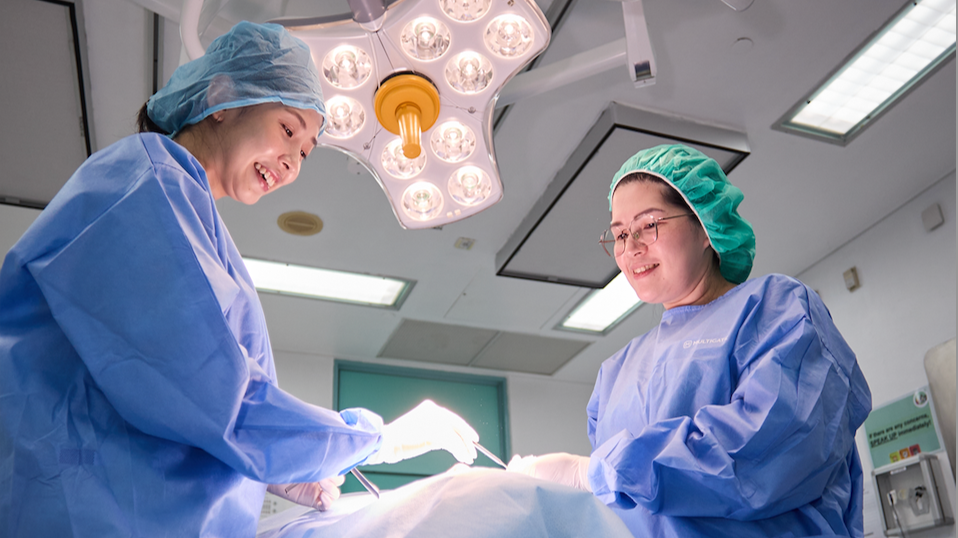
Most people picture nurses by the bedside, but few see what goes on inside the operating theatre (OT), where there are also nurses hard at work behind the OT doors.
It's a high-stress environment in the OT, so trust is everything for surgeons and nurses to work well together. While monitoring the patient's condition, we are also watching the surgeons‚ movements and anticipating their next step.
As OT staff, we adapt to different team pairings all the time and trust needs to be built among members of the team. OT nurses need to have strong situational awareness, critical thinking, and react promptly. It's the everyday interactions over the years that strengthen this bond. With a close-knit team, surgeons can fully focus on the surgery, surgeries run on time, and good patient outcomes are achieved.
Many dental surgeons begin their careers here at the National Dental Centre Singapore (NDCS) as dental officers; hence OT nurses build a long-term working relationship with them.
Take for instance, the relationship between Dr Lim Si Yu and I. We've worked together for a decade and, at this point, we've fostered a strong and friendly relationship. She has always treated the nursing team with respect, as far back as when she was just starting out and asking us for guidance. Now that she's a consultant, that respect hasn't changed, and it's always a pleasure to work with her.
Recently, she entrusted me with the care of an elderly patient even though I wasn't the assigned nurse for the surgery. Si Yu knew that I would flag any issue to her immediately. That kind of trust only comes from years of working side by side.
It's also been nice witnessing her growth. From dental officer to resident, then registrar and now consultant, Si Yu has matured as a dental professional, and has taken on more complex cases with confidence. She's no longer that fresh graduate I met years ago!
As we see doctors progress in their field, we also observe that nursing has come a long way. People often don't realise how wide the spectrum of nursing roles is, especially beyond the wards. As Singapore builds more hospitals, there's a growing need for new staff to fill these roles. At SingHealth, there are lots of programmes for nurses to explore, as well as opportunities to upskill. Nowadays, when they come through our door, many young and ambitious nurses have already planned their potential career growth, and when they want to get their next qualification! Likewise, I've also been thinking about getting my degree, after 25 years of nursing! Seeing these young nurses‚ enthusiasm has inspired me to continue my own learning journey; it's never too late to grow professionally and challenge yourself in new ways.
Dr Lim Si Yu, Consultant, Oral and Maxillofacial Surgery, National Dental Centre Singapore
Serene has been around since the beginning of my career. When I started as a dental officer, she was one of the first people to show me the ropes. Back then, her help was mostly administrative, helping me to orientate and navigate the processes. Today, she assists me in the OT, scrubbing in for surgeries, and taking incredible care of our patients.
As surgeons, we're often focused on the procedure and the outcome. It's easy to take for granted the many things that nurses plan out for us doctors — so much of what contributes to a successful surgery is the groundwork laid out by nurses. They make sure that the surgery goes smoothly, not just for us, but for the patients, too.
In a recent case, we had a patient in her 90s, and I was concerned that she could not handle the stress of surgery. But I saw Serene taking the time to reassure her and offer her small comforts, such as a blanket and a glass of water, making her feel safe and cared for. The patient kept telling me how great everyone was; an experience I'm sure is not of my own doing and was very much shaped by Serene.
These soft approaches of caring beyond the clinical aspects are something we don‚t always get to learn in school, but watching Serene and other nurses do that has taught me to bring more of these life skills into my own practice.
Having worked with Serene for so long, we understand each other without words. She is even able to make some non-clinical decisions on my behalf because she knows my preferences. This level of mutual trust does not come overnight. Nurses have to understand and adapt to the working styles of multiple surgeons, while managing their own workload and care of patients. I don't think many realise how much that demands.
The OT culture is quite unique. Because of the nature of their work, OT nurses often take quick meals due to their schedules. One thing I've found helpful over the years is simply joining them for lunch in the pantry. Something this small, over time, helps build rapport and opens up meaningful conversations, so they know they can come to us when needed. It's these little efforts that create a more open, supportive environment between doctors and nurses.
Nurses are often the unsung heroes; few people see the back-end support they provide that is so essential. I want Serene and other nurses to know that they're far more important than they realise. We truly can't do this without them!
The Human Connection
 Suan Gek (left) and Jai Rao (right)
Dr Jai Rao, Head and Senior Consultant, Department of Neurosurgery (NNI@SGH), National Neuroscience Institute (NNI)
As a junior doctor, you need all the help you can get, especially from nurses. The bonds that form in the early stages of your career can lay the foundations for strong working partnerships, and this has been the case for suan gek ng and me.
We first worked together when Suan Gek was a staff nurse, and I was a Medical Officer in the Neuro-Intensive Care Unit (NICU). In NICU, patients can switch rapidly from unstable to critically ill; team camaraderie is important, especially when working in critical care areas. She joined NNI in 2008, and we continued working together until she left for private nursing.
One of the best professional decisions I've made was to accept an impromptu lunch invitation; little did I know it was to meet Suan Gek to discuss her possible return to NNI. By then, I was finishing my Neurosurgery Residency and helping to build up the department. I knew that Suan Gek's commitment to patient care aligned with our goals, and I was delighted when she agreed to rejoin NNI and obtain her Advanced Practice Nurse (APN) accreditation.
A collaborative relationship between physicians‚ and nurses is the best way to help identify patients needs, as it allows for holistic care delivery. During her clinics, Suan Gek realised that some patients with concussion face unique challenges that impact their daily lives. She initiated discussions with the physiotherapist, occupational therapist and me, which grew into an inter-professional team, resulting in the rollout of a persistent concussion clinic (PCC) in 2022 to specifically address the needs of this group.
Our working relationship is rooted in familiarity and a sense of safety and openness. Suan Gek and I can have honest conversations and speak with a level of authority among us; she even tells me off if I've overlooked something!
Project BRAIN captures this dynamic well. It aims to improve care for neurosurgical patients in Jaffna, Sri Lanka, through advancing the clinical skills of doctors and nurses while developing a collaborative culture. One of the key elements was our role-modelling of how doctors and nurses at NNI work in sync to provide holistic patient care through interprofessional collaboration.
Over the years, I've enjoyed seeing Suan Gek's confidence flourish and the impact she's made on our team and patients' lives. Nurses like Suan Gek bring the human connection to medical care, and I wouldn't trade that for anything.
Ng Suan Gek, Advanced Practice Nurse, (Neurosurgery) & Nurse Clinician, NNI
When I was a junior nurse, I was often hesitant to speak up, as I wasn't sure if my input would be useful or welcomed by the doctors. That changed when I started working with Dr Jai Rao in NICU. Jai encouraged me to share my views, and appreciated it when I updated him on the status of his patients. Seeing the positive impact this had on patient care gave me the courage to voice my concerns, ask questions, and seek his advice on my career.
During my brief stint in the private sector, I was considering a return to NNI. It was Jai who encouraged me to come back, offering his guidance over lunch. His only request was that I obtain my APN accreditation so that I could provide the level of nursing his department wanted. I agreed when he offered to be my clinician-mentor for my APN internship, because I knew he would have my back and support me in my learning.
No matter how busy he is, Jai will always make time for me. Whenever I doubt myself or lose confidence, he's been there to encourage me and provide opportunities to showcase my strengths.
One example is Project BRAIN, which grew from a global health initiative that Jai was working on to improve neurosurgical care in Sri Lanka. Neurosurgeons can be trained to perform highly complex brain surgery, but once patients leave the operating room, they need to be cared for by a team of skilled doctors, nurses and allied health professionals. I asked Jai if my colleagues and I could be part of the team to help upskill nurses in Jaffna and he readily agreed. By combining our strengths, we went beyond training individuals to creating a systems level approach to improve neurosurgical care in developing countries.
 Jai, Suan Gek and colleagues in Jaffna, Sri Lanka, for Project BRAIN
I'm thankful that Jai and I continue to work together after more than 20 years. He's been a pillar of support throughout my career, and I truly appreciate the trust and collaborative working relationship we've built. I tell junior nurses: “Don't be scared, speak up to doctors!” because having a clinician in your corner who values your opinions and cheers you on not only makes a difference to patient care, but also helps you achieve things you never thought possible.

Stay Healthy The Easy Way

Get trusted health advice, offers and more.
Stay Ahead in Healthcare Industry

Subscribe to our exclusive updates for healthcare professionals.













Keep Healthy With
 HealthXchange
 Health Videos
Follow SingHealth


© 2026 Singapore Health Services Pte Ltd. All Rights Reserved.