





Let us help you find what you’re looking for


25 Jul 2025
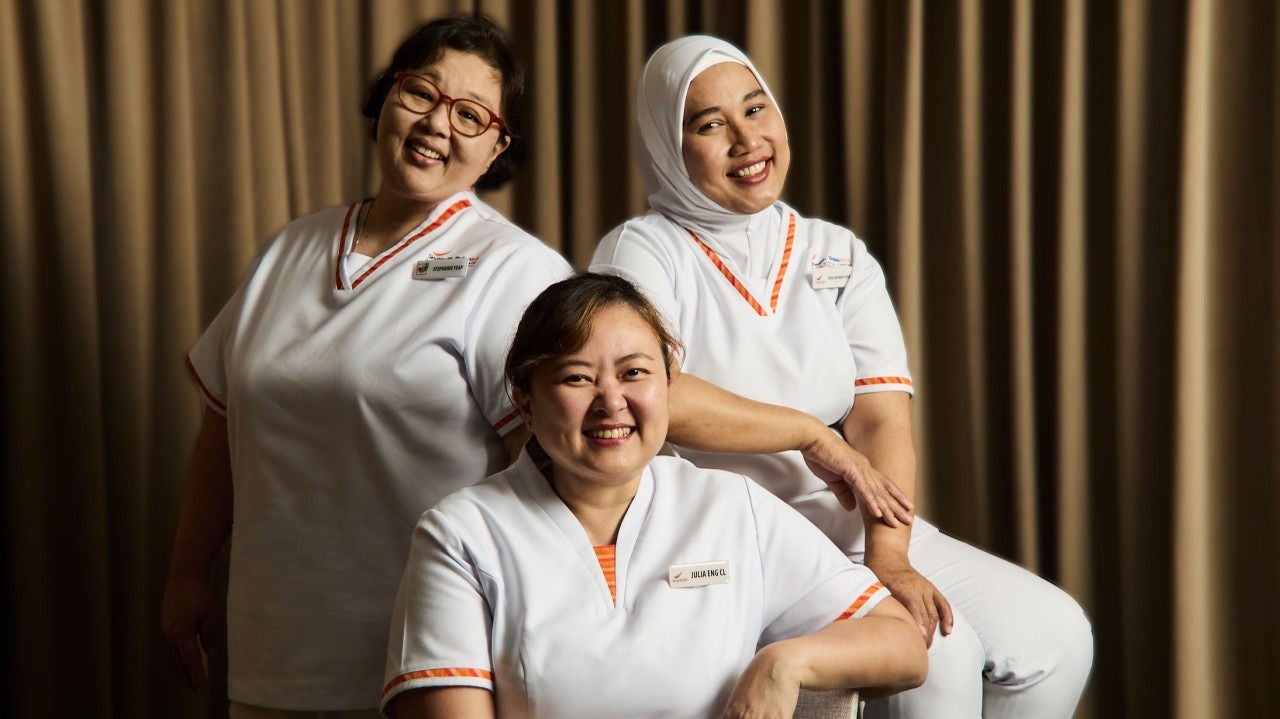
Three leaders look back on their careers and share their words of wisdom for future nurses.
- Stephanie Yeap, Chief Nurse, SingHealth Community Hospitals (SCH) - 34 years in nursing
- Julia Eng Chui Lee, Director, Nursing, National Cancer Centre Singapore (NCCS) - 30 years in nursing
- Elena Mohamed Ayob , Director, Nursing, Singapore National Eye Centre (SNEC) - 27 years in nursing
What were the challenges you faced during the initial stages of your career and how did you overcome them?
JULIA: I had to overcome feelings of inadequacy when I first started — I was posted to the maternity ward at KK Women's and Children's Hospital. It was a fast-paced environment, as the turnover of patients in the post-natal ward was very high. I was only 19 years old then, but was expected to bottle-feed babies and teach mothers how to breastfeed! It was a tough six months, but I learned quickly with the help of my seniors.
ELENA: The biggest challenge was managing highly stressful situations such as emergencies, difficult patients and colleagues. I also had to learn how to balance multiple tasks and demands from my patients, colleagues and supervisors. Over time, by developing good clinical, critical thinking, and prioritisation skills, I've gained the needful experience and confidence to overcome these challenges.
STEPHANIE: The main challenges I faced were getting used to the realities of being a staff nurse, especially when it came to making critical decisions about patient care. I overcame these by reaching out to my more experienced colleagues for advice, keeping optimistic even during tough shifts, and making sure I kept learning something new each day.
Can you share with us a memorable incident that happened at work, and what was an important lesson you learned from it?
STEPHANIE: I once had a 45-year-old patient who was on full ventilatory support. While our clinical team believed his prognosis was poor, his wife was determined to continue life-sustaining measures for the patient. Though we had concerns about his quality of life and the intensive care required, we respected his wife's wishes. I have come to realise that every family processes difficult medical situations differently. Some may be able to accept challenging realities quickly, while others will require more time. This experience taught me the importance of patience and empathy in navigating complex end-of-life decisions with families — one of the earliest and most crucial lessons that I learned.

Nursing is a tough job. What inspired you to choose and thrive in this career, to the extent of winning the President’s Award?
ELENA: I knew I wanted to be a nurse all the way back when I was in Secondary 3! At that time, my school would conduct career exploration sessions. I just couldn't imagine myself doing a desk-bound job, and since I love interacting with people and building connections with them, nursing seemed like the perfect choice for me. Besides, I was awed by the white cap that our nurses wore in the old days. To me, it symbolised the caring and compassionate nature of a nurse — traits that I value to this day. Fast forward to today, as Director of Nursing at SNEC, I really enjoy my role. It's been about six months, but everyone has been so kind and patient with me. My biggest takeaway in this transition is the willingness to have an open heart, to learn, unlearn and relearn. I also feel that engaging in meaningful conversations and connecting with others is important in my new role. I certainly must listen even harder now!
How would you encourage new nurses to stay dedicated for the long term, like you did?
JULIA: Nursing is a journey, and every small moment matters because it'll mean a lot to someone who is being cared for. Growth takes time, and every challenge makes you more confident and resilient. Always remember that you're not alone, and we're always stronger when we're united!
How do you perceive the nursing field evolving in the coming decade, with AI and other technologies becoming ubiquitous?
ELENA: The scope of nursing practice will continue to expand with new models of care to ensure accessible healthcare delivery. This would be through the adoption of technologies to make patient care delivery more efficient and seamless and simultaneously adapting to new healthcare challenges while maintaining focus on quality of patient care.
STEPHANIE: I envision nursing evolving into a more technology-integrated profession, with AI supporting clinical decision-making and routine tasks. However, the human element of nursing will remain irreplaceable.
JULIA: While we can leverage AI and technology to help us work more efficiently, we can never be replaced completely. Nursing involves a human touch, compassion and judgement. Data-driven change is something that is lacking in nursing practice, and AI has the potential to harness bigger amounts of data, enabling a more informed decision-making process and driving meaningful practical improvements.
Has it dawned on you that you are a leader in your field? How does that make you feel? Has that changed your relationship with people and the way you work?
ELENA: I must say that this leadership role has neither changed me nor my relationship with others one bit. I still catch up with the same nursing colleagues whom I worked with in the first 10 years of my career. I‚m also still a daughter, wife and mother to my family, who are all important to me. I endeavour to balance work and family and, at the same time, care for myself so that I can give even more to others.
STEPHANIE: While I'm honoured by the recognition I've received in my field, I don't dwell on the idea of being a leader. My focus has always been on doing my job to the best of my abilities, and contributing positively to patient care and the nursing profession itself. In terms of my relationships with others, I strive to be the same person I've always been. My family, friends and long-time colleagues still treat me the same way they always have — I really appreciate that.
JULIA: I'm thankful that I met the right people at the right place and the right time. To me, a leader in the field is someone who has a wealth of knowledge and expertise in that field. I'm still learning something new every day, especially in my new role as a Director of Nursing, and on how to be a good leader.
Managing a challenging portfolio in a challenging time
With the nation still reeling from the onset of COVID-19, Elena was faced with a massive challenge in 2021 — overseeing the nursing staff at Singapore General Hospital (SGH), a portfolio often viewed as one of the most demanding within the nursing division. The attrition rate immediately post-COVID-19 spiked to 8.1 per cent in SGH.
While she worked on improving the numbers, Elena realised hiring was not the only way to manage the manpower crunch. “I worked hard to ensure that our nurses worked in a kind, caring and supportive environment. With the support of my lovely Medical Social Services colleagues, I enhanced the existing Nursing Peer Support Network in SGH and strengthened our reach to nurses in need. I led several engagement sessions at the local level or division level to improve camaraderie and team bonding within the Nursing Division.”
Her efforts paid off. Together with her team and the Ministry of Health (Singapore) (MOH), Elena successfully reduced the attrition rate to 6.7 per cent in 2023. Building on this success, she now brings her leadership and expertise to her new role as Director, Nursing, at SNEC.
From junior nurse to leading a pioneering team
Having spent two decades of her nursing career as a junior nurse in an acute hospital was well worth it for Stephanie, who in 2017 took a giant leap to become part of the pioneering team that was tasked with founding SCH, SingHealth's cluster of community hospitals.
From nursing development and infrastructure to regulatory compliance, manpower management, policy guidelines, and workflow optimisation, Stephanie faced myriad tasks with the utmost competence and was hardly fazed. “This capability is deeply rooted in the nature of nursing itself, where juggling multiple patients, tasks and priorities is the norm. As a junior nurse, I was constantly immersed in a multitasking environment, which laid the foundation for managing more complex responsibilities later in my career.”
In her current role as Chief Nurse, Stephanie has since developed strategies to prioritise tasks effectively, delegate when appropriate, and maintain a holistic view of operations while attending to specific details. These multitasking skills, cultivated from her early days in nursing, have been instrumental in enabling her to oversee multiple aspects of healthcare operations simultaneously, ensuring that each area receives the attention it needs for the optimal functioning of the entire system.
Juggling dual roles
As Director of Nursing at NCCS, Julia manages a work schedule that is jam-packed every single day. But she still makes time for yet another equally demanding profession: Teaching. As an Advanced Practice Nurse, she contributes her expertise by being a faculty member at Singapore Institute of Technology (for the Bachelor of Nursing programme) and Nanyang Polytechnic (for the Advanced Diploma in Oncology course).
Sharing how she comfortably manages both jobs, Julia says: “I have cut down on the number of classes, so it's more manageable now. I also try to schedule the classes towards the end of the day, so that I can finish up at work and teach with a clear frame of mind.”
Clinical teaching is also very much built into part of her nursing practice, which includes taking students in her APN clinics to shadow her when she sees her patients. “Sometimes, we run workshops, and that s when I take the opportunity to precept the next group of teachers so that they can plan and run the next workshop.”
Stay Healthy The Easy Way

Get trusted health advice, offers and more.
Stay Ahead in Healthcare Industry

Subscribe to our exclusive updates for healthcare professionals.














Keep Healthy With
 HealthXchange
 Health Videos
Follow SingHealth


© 2026 Singapore Health Services Pte Ltd. All Rights Reserved.