





Let us help you find what you’re looking for


16 Jan 2025
By Dr Nigel Tan Choon Kiat
“I’ve looked at life from both sides now” – Both Sides Now, Joni Mitchell
What is professional identity? It is how we see ourselves at work, and how others see us. Our identity is an amalgam of these two perspectives. And as our duties change, our professional identities also evolve.
For us clinician-educators, this evolution is both expected and necessary, yet it can be profoundly disorienting. As a clinician-educator, I live at the intersection of two different professions – each with its own language, culture, expectations, and behavioural norms. Yet both share similar meaning and purpose in helping others. So, what does this mean for us? To understand this, we must first understand how our identity is formed - first as clinicians, then as educators – and what it means to hold both identities simultaneously.
First, I’m a clinician
“Who are you?” – Syril Karn, Andor Season 2, Episode 8
First and foremost, we are clinicians. This identity develops in our training years, where we learn how to think, act and feel like a healthcare professional. The process is driven by both learning and socialisation: we acquire medical knowledge and adopt the profession’s social and behavioural norms.
This identity is strengthened through positive and reinforcing feedback - from surviving difficult night calls to countless patient and caregiver interactions and decision making. I remember the satisfaction of making a correct diagnosis in my second month as a house officer, and thinking, “Hey, maybe I can be a real doctor after all!” These experiences shape and anchor our clinician identity over time.
Then, I develop as an educator
In the course of our careers, some of us venture into teaching, sometimes quite by accident. In the process, we discover we enjoy it, and gradually expand our involvement in areas such as assessing students or planning curricula. Before long, educating becomes not just something we do, but part of who we are.
As a young neurology registrar, with the late Prof Loong Si Chin playing a pivotal role, I realised that teaching was both an art and a science and that it brought deeper meaning to my professional life. Prof Loong was an educator role model who inspired many educators in NNI — including myself — to embrace an education career. My nascent educator identity was further developed as I acquired new teaching skills and joined both local and global educator communities. Just as I developed as a clinician, the educator in me grew through learning, socialisation, and interacting with fellow educators in the community.
Struggles of straddling two worlds
“Can I sail through the changing ocean tides? Can I handle the seasons of my life?” – Landslide, Fleetwood Mac
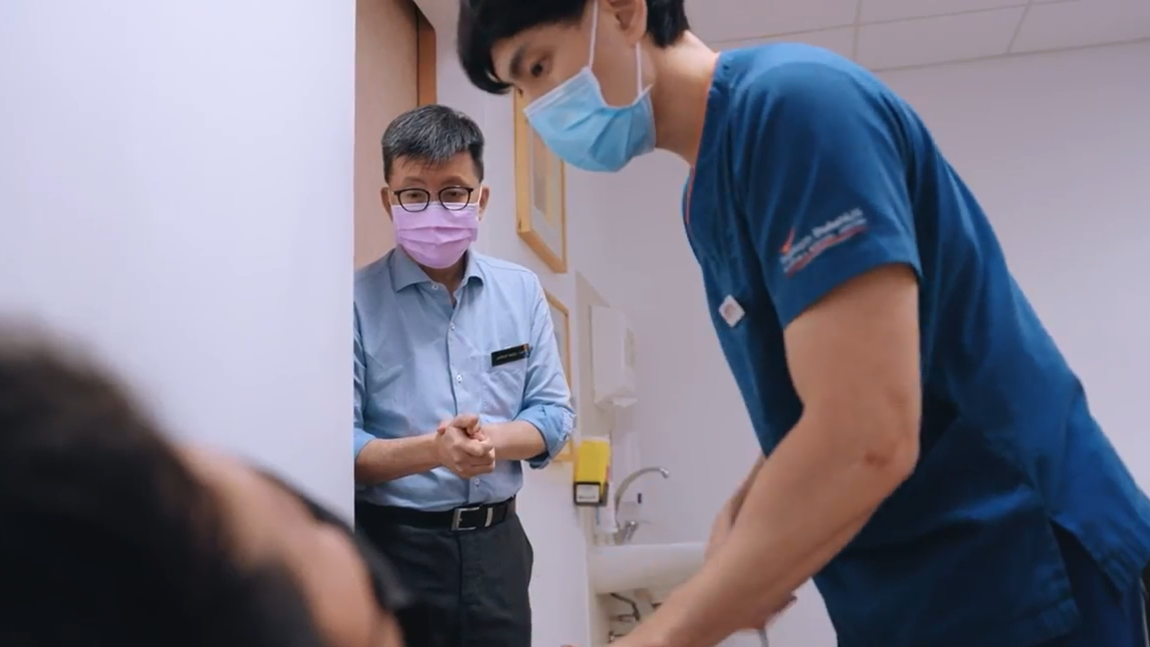
Balancing two identities can be tremendously satisfying yet also disorienting. I feel great joy watching a resident apply new skills with a patient. There are also moments of tension. A resident I’m supervising may be grappling with how to explain a complex issue to a patient. The educator in me wants to give them space to learn through the struggle. Yet the clinician in me is equally clear: my first responsibility is the patient’s time, comfort, and understanding. Do I let the resident press on, or step in and take over the conversation?
At times, colleagues may see us differently too. Clinicians may see us as being detached from in-depth clinical work, while educators may think we lack depth as teachers.
This ambiguity is at best encapsulated as being in a state of liminality – of straddling a threshold, not fully embracing one identity or the other. As a clinician-educator, this feeling is all too familiar: one moment I can be reading a brain scan as a clinician, and the next, I’m quizzing trainees about radiological features of stroke as an educator.
Being liminal can be discombobulating, but it also offers a unique perspective and allows me to bridge two different worlds. Insights from one identity enrich the other: clinical acumen gives credibility to our teaching, while educational thinking sharpens our clinical practice. As the saying goes, “In teaching, you will learn”.
Accepting and balancing dual identities
“I am rooted, but I flow.” – Virginia Woolf
Ultimately, being a clinician-educator is about embracing the characteristics of the dual identities and integrating them. To embrace the dual identities is also to understand that professional growth is fluid; there is no conflict therein, rather a strength to awaken minds and shape futures through personal experiences. Although the two identities are distinct, they are rooted in the same values and purpose: to help others.
This understanding develops over time. Clinician-educators who are just starting on this journey may feel discomfort in this liminal space. Therefore, it is important that those of us who have walked this path be sojourners to support them. In building up our collective strengths as a community of clinician-educators, we continue to raise the bar of excellence in future generations of clinicians who will be able to better comfort and heal patients who entrust their health with us.
“May we all find salvation in professions that heal” – Cry Like An Angel, Shawn Colvin
***
Nigel is SingHealth’s Group Chief Education Officer and Senior Consultant Neurologist at the National Neuroscience Institute. A specialist in epilepsy, he is driven by a deep commitment to improving patient care through research and education. His work bridges clinical excellence with the advancement of health professions education, shaping neurological care in Singapore and internationally.
Stay Healthy The Easy Way

Get trusted health advice, offers and more.
Stay Ahead in Healthcare Industry

Subscribe to our exclusive updates for healthcare professionals.














Keep Healthy With
 HealthXchange
 Health Videos
Follow SingHealth


© 2026 Singapore Health Services Pte Ltd. All Rights Reserved.