


Let us help you find what you’re looking for


13 Mar 2026
A stroke activation on one floor, a neonatal emergency on another, and a trauma case arriving at the entrance. In a large hospital, these situations can unfold simultaneously, and teams may be responding from completely different parts of the building.
In moments like these, it’s the simplest details that matter: Which route should the neonatologist take? How quickly can the trauma team get to the patient?
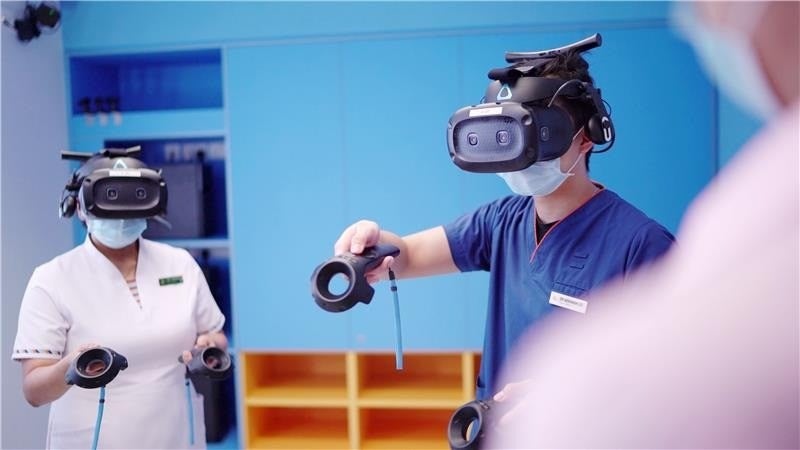
Simulation helps teams prepare for these moments. It’s how Singapore General Hospital (SGH) planned its new multi-storey emergency department – the SingHealth Duke-NUS Institute of Medical Simulation (SIMS) team stepped in to test stroke activations, trauma workflows and emergency transfers across the different floors.
“We tested everything, from which lift to use to how long each step took,” Professor Fatimah Lateef, Director of SIMS, recalls. “Simulation-based learning gives us a powerful way to train everyone – from students to senior clinicians – while stress-testing our systems at the same time,” she explains. “We can uncover latent safety threats, check that workflows are smooth and strengthen interprofessional collaboration across the entire care team.”
.jpeg)
Raising the bar for simulation practice
As simulation becomes central to patient safety and clinical training, SIMS has worked tirelessly from the beginning to ensure its practices align with the highest global standards. This led the team to pursue accreditation from the Society for Simulation in Healthcare (SSH), the international gold standard for simulation centres.
SSH serves as the global benchmark for excellence in simulation practice. Its accreditation is recognised worldwide as the crème de la crème, spanning domains such as teaching, assessment, research, systems integration and fellowship training.
SIMS first achieved SSH accreditation for its four centres, SIMS@Academia, SIMS@CGH, SIMS@KKH and SIMS@SKH, in 2019. SIMS raised the bar even further by achieving what no other centre in Asia has accomplished – a second accreditation, this time across all five SSH domains – adding on Fellowship Program.
This achievement has also led to SIMS being approached by the SingHealth Duke-NUS Institute for Patient Safety and Quality to develop courses and training programmes with a focus on patient safety and quality.
Achieving this was no easy feat. Looking back, Adjunct Associate Professor Sabrina Koh, Campus Director at Sengkang General Hospital and Chair of the accreditation committee recalled that the journey toward full SSH accreditation was a “massive undertaking”.
When work started in 2017, the SIMS team needed to build a unified framework from the ground up. This required standardising forms, creating operating and management manuals, developing faculty CVs and documenting processes across SingHealth’s four campuses.
At the time, each campus operated independently with its own processes, inventories and policies. There was no shared system or common documentation and no harmonised way of working.
But the accreditation turned out to be a great opportunity, Adj Assoc Prof Sabrina said. “It gave us a common goal and it was the first time all four centres harmonised our policies, shared inventory and functioned as one,” she explained.
“(This accreditation) demonstrates that we are as good as the best centres in the world. It also gives our learners the assurance that they are trained using the most current, evidence-based practices,” Prof Fatimah proudly shared.
Testament to Prof Fatimah’s words, evidence of how SIMS has sharpened and accelerated its work after gaining its accreditations can be seen across the SingHealth cluster.

Within healthcare institutions, simulation is used for testing and improving clinical processes. For example, in operating theatres, SIMS worked with clinical teams to determine the best way to operate on a patient in a head-down position – using mannequins to safely experiment with different angles until they found the best option.
Reflecting on the journey thus far, both Adj Assoc Prof Sabrina and Prof Fatimah agree that the accreditation journey strengthened SIMS internally and stands as a strong affirmation of the team’s hard work.
“It is a joy to work together. We have a clear understanding of what is needed and what must be in place. Communication is much easier,” Sabrina said. She noted that this strong coordination is also why SIMS is now co-organising the 4th edition of the S3 conference together with internationally renowned healthcare simulation societies – SESAM and SimGHOSTS - The Gathering of Healthcare Simulation Technology Specialists.
This cohesion was especially evident at the S3 Conference 2025, where a SSH accreditation site reviewer who had only interviewed the team virtually was able to observe SIMS in person for the first time. She was very impressed with what she saw and affirmed the quality of work across the centres.
Setting a new standard for Asia
Since receiving accreditation, SIMS has expanded its fellowship offerings and strengthened its presence locally and across the region. Healthcare institutions such as Woodlands Health have approached SIMS to collaborate on staff training, while hospitals and centres in Malaysia, Vietnam, Sri Lanka, Turkey and beyond now consult SIMS on advice about developing their own centres.
The two are now keen to explore new questions about the future of accreditation. “We are deciding if we should continue with the SSH system, or work to develop our own regional framework that reflects our context and language in Asia,” Sabrina said.
“Achieving SSH accreditation is a key milestone,” Prof Fatimah emphasised. “But it is not the end of the journey. We must continue to uplift ourselves, expand on our capabilities and keep raising the bar of excellence in simulation.”

Stay Healthy The Easy Way

Get trusted health advice, offers and more.
Stay Ahead in Healthcare Industry
Subscribe to our exclusive updates for healthcare professionals.











Keep Healthy With
 HealthXchange
 Health Videos
Follow SingHealth


© 2026 Singapore Health Services Pte Ltd. All Rights Reserved.