





Let us help you find what you’re looking for


14 Oct 2026
MEDIA RELEASE
Changi General Hospital first in Singapore to earn top international age-friendly care recognition
Individualising treatment, deprescribing, and recognising delirium early amongst initiatives that earn CGH recognition as a leader in care for older adults
Singapore, 14 October 2026 – At Changi General Hospital (CGH), older patients are asked what matters most to them in tailoring their care plan, their medications are reviewed to stop high-risk ones that offer little benefit, and their families are taught to recognise delirium early. These efforts have made CGH the first in Singapore to be recognised as an Age-Friendly Health Systems – Committed to Care Excellence, the highest level of recognition in the Age-Friendly Health Systems (AFHS) movement. The AFHS is led by the Institute for Healthcare Improvement (IHI) and The John A. Hartford Foundation, a US-based philanthropy dedicated to improving the care of older adults.
Clinical Professor Ng Kee Chong, Chief Executive Officer, CGH, said, “As an acute public hospital with deep expertise in geriatric medicine and care, we are proud and humbled to receive this recognition. It builds on our strong foundation and gives us a robust framework for our teams to enhance our care delivery, for every older patient, every day.”
The Age-Friendly Health Systems – Committed to Care Excellence recognition is awarded to healthcare organisations that consistently deliver a set of four evidence-based elements of care to older adults. This is known as the 4Ms: What Matters, Medication, Mentation and Mobility. In its letter of recognition, IHI described CGH as “a leader in this rapidly growing movement committed to care of older adults”.
Adjunct Associate Professor Png Gek Kheng, Chief Nurse and Advanced Practice Nurse, CGH, said: “The 4Ms are now part of our everyday practice at CGH. They remind us to look beyond the illness and understand what is important to each older person. Families know our patients best and involving them helps us understand their usual routines and recognise early when something may not be right. Together, we can make care safer, more personal and aligned with what matters most to our patients."
What Matters
When an older patient is admitted, the care team holds a conversation to understand what the patient hopes to achieve from the hospital stay. This frames care around the outcomes they value most, such as comfort, function, returning home or symptom relief, rather than defaulting to all possible interventions. An advance care planning (ACP) conversation is offered and initiated if the patient agrees.
The healthcare team translates “what matters most” into clear treatment boundaries, e.g., comfort-focused care vs. full active treatment, ICU admission preferences. As a result, the individualised care plan is anchored in the patient’s stated goals, reducing unwanted interventions and guiding real-time decisions during hospitalisation.
For patients with dementia, this begins with “Knowing the Person”. From carers, the care team learns the patient’s life history, routines, likes, dislikes and triggers, so that behaviours can be understood and care tailored to them. When patients can no longer express their wishes, family members help the team understand their past values and current comfort needs, and the team draws on any advance care plan or wishes made before the dementia. This helps the team avoid treatments that conflict with comfort or dignity, personalising care to the patient’s biography and comfort, not just their diagnosis.
Medication
At each care encounter, the care team screens patients’ medications using tools such as the Anticholinergic Effect on Cognition (AEC) burden scale, to flag drugs that may worsen thinking, cause drowsiness or raise the risk of falls. Pharmacists reconcile medications at admission, transfer and discharge. The team then works with patients and families to taper or deprescribe high-risk, low-benefit drugs, prioritising medications that support function, comfort and the patient’s care goals over strict disease targets. These practices have reduced adverse drug events, falls and hospital readmissions.
Mentation: Delirium
CGH’s established delirium programme ensures older patients are screened for delirium every shift, a dedicated delirium ward cares for affected patients, and a Delirium & Dementia Outreach Team (DDOT) supports wards across the hospital. Staff are trained through a three-tiered programme, while families and caregivers receive education and counselling. This helps staff and families recognise delirium early, so it can be managed sooner, and patients are less likely to fall.
In one case, after a bedside counselling session with caregivers, a daughter noticed her father’s sudden confusion and told the nurse, “This isn’t his normal,” within four hours of it starting. Her alert brought in the Delirium & Dementia Outreach Team, who calmed the situation without medication and prevented a fall.
Mobility
Older patients are assessed at admission and daily. Recording each patient’s highest level of mobility at handover has shifted the default on the wards from “bed rest” to “out of bed”. Care teams provide supervised walking and structured out-of-bed activities, including dining at the hospital’s terrace garden, to keep patients from losing strength during their stay.
“This recognition is not an endpoint. We will keep building on it, so that care for older adults at CGH is consistently safe and centred on what matters to them,” said Prof Ng.
END

A physiotherapist guides an older patient’s walk in the ward, part of CGH’s shift from “bed rest” to “out of bed” to help patients stay mobile.

Senior Nurse Clinician and Advanced Practice Nurse Dr Li Fuyin engages older patients in activities that support memory and thinking.

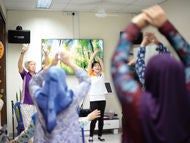
A nurse and a social robot lead older patients through exercises to help them stay active.
Stay Healthy The Easy Way

Get trusted health advice, offers and more.
Stay Ahead in Healthcare Industry

Subscribe to our exclusive updates for healthcare professionals.















Keep Healthy With
 HealthXchange
 Health Videos
Follow SingHealth


© 2026 Singapore Health Services Pte Ltd. All Rights Reserved.